How a Gin Bar Keeps Guests Coming Back
A good gin bar can attract first-time visitors with novelty. A great one earns repeat business with memory, trust, and a sense of belonging. Those are not the same thing.
Plenty of places can stock fifty bottles and print a clever menu. That might fill seats for a month or two. It does not explain why guests choose one room over another on a wet Thursday, or why they bring friends back the next time. Repeat custom in hospitality is usually built from smaller, less glamorous decisions. The way the tonic is poured. The way staff speak about juniper without sounding rehearsed. The way the lighting settles the room at 8:30 p.m. The way a guest who visited six weeks ago is greeted like someone worth remembering.
A gin bar lives in a particularly demanding category. Gin drinkers tend to notice detail. They care about garnish, glassware, dilution, temperature, and style. They often arrive with strong preferences, and just as often, they are open to discovery if they trust the person guiding them. That makes the category rich with opportunity, but it also leaves very little room for lazy execution.
What keeps guests coming back is not mystery. It is the discipline of getting the fundamentals right, then giving people enough freshness that a second visit feels different from the first.
The first return is the real test
Most operators pay close attention to first impressions, and they should. But the more revealing question is this: what makes someone return within thirty days?
In my experience, guests come back to a gin bar for one of three reasons. First, they felt understood. Second, they had a drink they cannot easily recreate elsewhere. Third, the room made them feel better than they did before they walked in. When all three happen together, loyalty starts to form.
That sounds obvious, but many bars miss it by focusing on surface markers of quality. They build a long back bar, train staff to recite tasting notes, and commission a beautiful menu. Then they overlook the guest who does not want a lecture, only a crisp martini and a seat where conversation is possible. Hospitality is not displayed, it is interpreted. The same bottle selection can feel welcoming in one bar and pretentious in another, depending on how it is presented.
A successful gin bar usually wins the second visit before the first one is over. It plants an unfinished thought. Maybe a guest tries a London dry martini and the bartender mentions a softer Japanese gin they might enjoy next time. Maybe a couple order one round and end up talking to staff about regional tonic differences. Maybe a solo guest finds a corner stool, a proper drink, and just enough attention. The point is not to sell harder. The point is to leave one good reason to return.
The menu matters, but not the way owners often think
A common mistake is treating the gin list as the star attraction. It is important, of course. A serious gin bar needs range and point of view. But guests are not impressed by quantity alone, at least not for long. Two hundred bottles can be a strength, or it can be a symptom of indecision.
The best gin menus are curated, not merely accumulated. They show breadth across style, origin, and flavor profile, but they also help a guest navigate. That means the menu must answer practical questions quickly. Is this gin citrus-led or spice-forward? Will it shine in a G and T, or is it better in a martini? Is it robust enough for Negroni service? Is the price gap between pours meaningful, or just ornamental?
A guest should never need advanced spirits knowledge to order confidently. In a strong gin bar, the menu acts less like a catalogue and more like a host. It guides without cornering. It suggests without scolding. It leaves room for both the enthusiast and the person who simply knows they like something “clean, cold, and not too floral.”
This is where brief, well-written descriptors do more work than dramatic naming. I have seen bars spend weeks inventing cocktail titles that say very little about the drink itself. Meanwhile, a line such as “bright citrus, dry finish, ideal with rosemary and Mediterranean tonic” can make a hesitant guest order immediately. Clarity sells. So does honesty.
There is also a commercial side to menu design that operators ignore at their peril. Repeat guests notice value, even in premium environments. Value does not always mean cheap. It means coherence between price, quality, service, and experience. If one signature gin cocktail is priced at a premium, it needs to justify that price not just with ingredients, but with balance, technique, and presentation. People forgive expensive drinks less easily than they forgive expensive food, because the ratio of cost to consumption feels more immediate.
Staff create loyalty faster than décor ever will
A handsome room brings people through the door. Staff decide whether they return.
That is especially true in a gin bar because the category lends itself to conversation. Guests often ask what distinguishes one bottle from another, why one tonic works better than another, or whether a certain garnish is traditional or just fashionable. Those moments can either deepen trust or expose a weak operation.
The strongest staff are not necessarily the ones with the most encyclopedic knowledge. They are the ones who can read a table and adjust. One guest wants detail on distillation methods. Another wants a quick recommendation before their friends arrive. Someone else says they hate gin, but then admits they once had one they liked with grapefruit. A skilled bartender hears that and starts building a bridge.
Training for a gin bar should cover product knowledge, certainly, but it also needs to cover translation. Can the team convert technical language into useful guidance? Can they explain why a higher-proof gin changes the texture of a martini? Can they gently steer a guest away from a poor choice without sounding corrective? Can they recover from a drink that missed the mark?
Those recovery moments are often where loyalty is won. When a guest says, “This is a little too bitter for me,” the response matters more than the mistake. A defensive bartender loses trust immediately. A confident one says, “No problem, let me fix that,” and returns with something better suited to the palate. Guests remember being looked after. They remember feeling safe spending money in a place that will make things right.
There is also huge value in continuity. If the same bartender or server remembers a returning guest’s preference for a dry, saline martini with a twist, that recognition lands hard. It does not need to be theatrical. A simple “You liked the navy-strength pour last time, do you want to go that route again?” can do more for retention than any loyalty card ever will.
Signature drinks should feel specific, not generic
Many gin bars fill their menu with drinks that could exist anywhere. Elderflower, cucumber, pink pepper, edible flowers, premium tonic, served tall. Pleasant enough, quickly forgotten.
Repeat business depends on distinction. Signature serves need a point of view. That does not mean every cocktail must be eccentric or difficult. It means the drink should reflect the bar’s identity, local context, or technical confidence in a way guests can taste.
A coastal bar might lean into saline, herbaceous, bracing profiles that suit seafood and sea air. A city-center bar might build a sharper list designed for quick precision, martinis, and polished classics. A neighborhood gin bar may do better with deeply drinkable highballs and seasonal long serves that support conversation over several rounds. The key is alignment. Guests can tell when a menu was designed for the space versus copied from broader trends.
Seasonality helps here, but only if it is handled with restraint. A spring menu that introduces one or two fresh ideas gives regulars a reason to look again. Constant reinvention can backfire. People return partly because they want to revisit the drink they told friends about. If a bar replaces its entire personality every eight weeks, it asks too much of loyal guests.
A practical approach is to keep a stable spine of excellent classics and house signatures, then rotate a smaller set of seasonal features. That balance gives regulars both reassurance and curiosity.
The gin and tonic still decides a lot
For all the creativity a gin bar may showcase, many guests judge the place on the quality of its gin and tonic. They are right to do so.
The drink looks simple, which is precisely why errors stand out. Poor ice quality, warm tonic, over-handled garnish, incorrect ratio, or tired carbonation all flatten the experience. A guest might forgive a slightly overambitious cocktail. They rarely forgive a mediocre G and T in a bar that claims to specialize in gin.
The best bars treat the serve with near-ritual seriousness, but without turning it into theater for theater’s sake. Large, cold ice. Freshly opened tonic. Glassware that suits the style of serve rather than whatever photographs best. Garnish chosen to support the botanical profile, not overwhelm it. Attention to proportion. Those details are not fussy, they are foundational.
One of the simplest retention tools in a gin bar is offering a house-standard G and T that is unmistakably better than what most guests make at home. That may sound modest compared with complex cocktail development, but it is commercially powerful. If a guest thinks, “I can get a better gin and tonic here than anywhere nearby,” the bar has already earned a place in their rotation.
Atmosphere is built minute by minute
Owners often talk about atmosphere as if it were a design feature installed before opening. It is not. It is produced in real time through dozens of operational choices.
Volume is one of the most underestimated. A gin bar usually benefits from conversational sound rather than club-level intensity, at least for a large share of service. If guests have to lean across a table and shout through a first round, many will not stay for a second. A room that supports conversation keeps dwell time healthy, and longer dwell time often means another drink and a better chance of return.
Lighting works the same way. Too bright, and the Gin Bar room feels clinical. Too dark, and the menu becomes work. Somewhere in the middle sits that flattering, calm, quietly expensive glow that invites people to settle in. Gin Bar The most successful bars tune lighting by daypart. Early evening can tolerate more brightness. By late service, the room should soften.
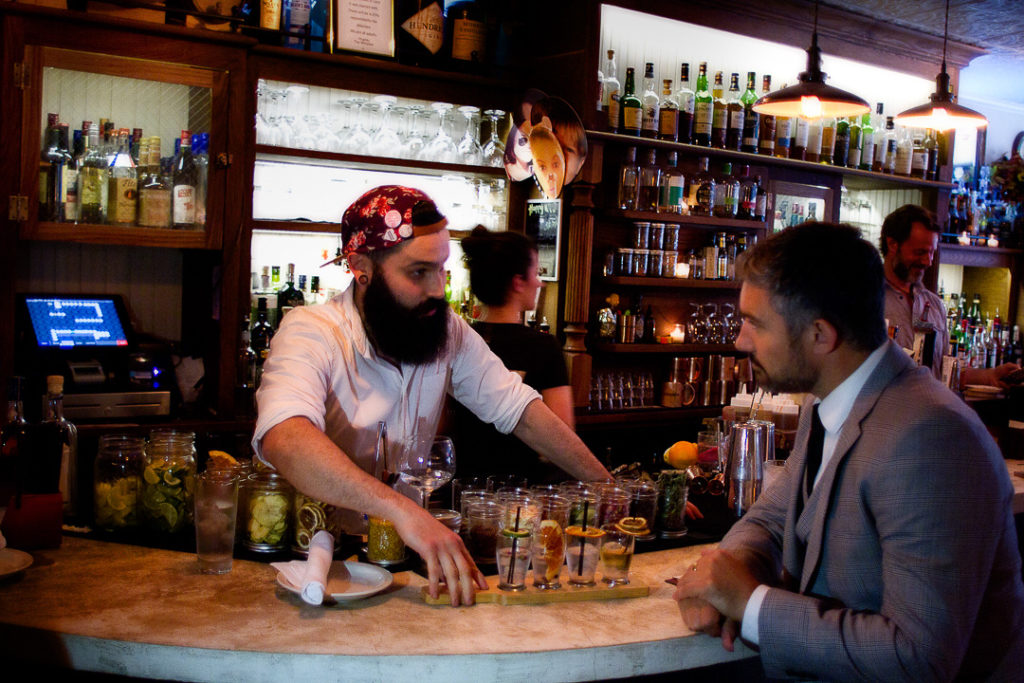
Then there is pacing. Guests notice when they are rushed, and they notice when they are abandoned. A good gin bar understands the rhythm of different parties. Pre-dinner guests may want speed. A date may want space. A group exploring several gin flights may appreciate occasional guidance without constant interruption. Service that matches the tempo of the table feels intuitive, even when it is highly intentional.
Cleanliness has its own quiet effect on loyalty. No one writes glowing messages to friends about spotless menus or polished glassware, but people absolutely remember sticky tables, smeared stems, or tired bathrooms. These are not glamorous fixes, yet they shape whether a bar feels trustworthy.
Regulars are earned through memory
The surest sign that a gin bar has moved beyond novelty is the emergence of regulars who visit without needing an occasion.
Those guests are not won through discounts alone. They are won through recognition and relevance. The bar learns what they like, what they avoid, when they tend to visit, and what kind of interaction they prefer. Some regulars want to chat at the bar and try every new bottle. Others want the comfort of consistency, their usual seat, their usual drink, and a quiet nod.
Remembering preferences is one part system, one part culture. A reservation note helps. A shift handover helps. More than anything, a staff culture that values attention helps. Bars that keep guests returning usually have teams who treat memory as service, not performance.
A few practical habits make a disproportionate difference:
- Note returning guests’ preferences discreetly, especially martini specs, favored gins, and allergies.
- Train staff to offer one relevant suggestion, not three overwhelming ones.
- Keep at least a handful of permanent serves unchanged, so regulars can revisit favorites.
- Follow consistency standards tightly on ice, tonic, garnish, and glassware.
- Make departures warm and specific, so the last impression encourages the next visit.
None of this requires grand technology. It requires observation and follow-through. When guests feel that the bar recognizes them without crowding them, loyalty deepens.
Events can drive traffic, but habit drives survival
Gin tastings, distiller takeovers, pairing dinners, and masterclasses can be excellent for a gin bar. They create energy, generate social content, and introduce new guests to the room. They can also become a crutch if the core experience is not strong enough to stand alone.
A one-off event fills a Tuesday. Habit fills the rest of the month.
The most effective events support the everyday identity of the bar instead of distracting from it. A tasting that teaches guests how different tonic styles change a serve can be valuable because it connects directly to what the bar does nightly. A meet-the-distiller evening can work if staff are ready to convert that interest into future recommendations. A special menu tied to local ingredients can make sense if it feels like an extension of the house style.
What does not work as well is using events to compensate for weak fundamentals. If service is uneven and the room lacks cohesion, a busy event may create short-term revenue while quietly discouraging repeat visits. People return for the standard, not the exception.
Food, even in a small role, changes the equation
Some gin bars resist food because they want to remain drinks-led, or because kitchen operations complicate the model. That is understandable. Still, even a tightly edited food offer can dramatically improve repeat custom.
Guests stay longer when they can eat something thoughtful. They are more likely to order a second or third drink. They are more willing to make the bar a planned evening stop rather than a single-round detour. Food also broadens the audience. Not every potential regular wants a late-night spirits-only environment.
This does not require a full kitchen. In many cases, a small menu of well-executed bar food is enough. Good olives, quality tinned fish, charcuterie, proper crisps, a warm savory item or two, perhaps one strong vegetarian option. The standard matters more than the size of the offer. Sparse and excellent beats broad and forgettable.
The style of food should match the drinks and the room. A sharp martini bar can thrive with oysters and salty snacks. A more relaxed neighborhood gin bar may be better served by hearty small plates. The right food tells guests the bar expects them to stay awhile.
Consistency is less exciting than innovation, and far more profitable
There is constant pressure in hospitality to launch, refresh, reinvent, and chase whatever is getting attention. Some of that is necessary. No bar can afford to grow stale. But bars that retain guests for years usually do something slightly unfashionable. They repeat themselves, carefully.
They repeat excellence in the things that matter. The coldness of the martini. The shape of the welcome. The timing of the second round check-in. The confidence of the recommendation. The quality of the tonic. Guests do not come back because everything changes. They come back because the important parts do not.
That takes operational discipline. Recipes must be documented. Garnish standards must be maintained even on busy nights. Glassware par levels must be protected. Staff training cannot stop after opening month. Managers need to taste, watch, listen, and correct. A gin bar that feels effortlessly reliable usually sits on top of a lot of very deliberate effort.
The room should have a reason to exist
This may be the most important point of all. A gin bar keeps guests coming back when it has a clear reason to exist beyond serving gin.
That reason might be expertise. It might be neighborhood warmth. It might be a superior martini program. It might be a devotion to classic service. It might be a sharp local identity that no chain can imitate. Whatever it is, guests need to feel it without reading a mission statement.
I have seen compact bars with fewer than forty covers outperform larger, better-funded competitors because they knew exactly who they were. Their bartenders spoke with confidence, not script. Their menus were edited. Their regulars felt ownership. Their drinks were not merely photogenic, they were satisfying. Most of all, the experience made sense from start to finish.
Guests come back when a bar becomes part of their map of reliable pleasures. Not the loudest room, not the most elaborate back bar, not the place with the newest bottle every week. The place where they know they will be looked after. The place that gets the drink right. The place that keeps its standards when the room is full. The place they mention without hesitation when someone asks where to go for gin.
That is how a gin bar builds return business. Through precision, memory, restraint, and character. Through choices that respect the guest’s time, money, and palate. Through a hundred small acts of competence that add up to trust.
Trust is what fills the seats again next Friday.
The Winslow
243 E 14th St
New York, NY 10003, United States
Phone: +1 212-777-7717
FAQ About Gin Bar
How to do a gin tasting?
Start with a small pour and gently smell the gin before taking a small sip. Notice its juniper, citrus, floral or spice notes, then compare how the flavor changes with a little water or tonic. At a gin bar, ask the bartender to explain the selection and botanical pairings.
How to make the best tasting gin and tonic?
Use chilled gin, fresh tonic and plenty of ice. A common starting ratio is one part gin to two parts tonic, adjusted to taste. Choose a garnish that complements the gin's botanicals and stir gently to preserve the bubbles.
What is the smoothest tasting gin?
There is no single smoothest gin for everyone. Perceived smoothness depends on the botanical recipe, alcohol strength, serving temperature and mixer. Describe whether you prefer citrus, floral, herbal or juniper-forward flavors so a bartender can suggest a suitable style.